Skip to content


Sony Ericsson with best new app store yet

Just days after I wrote about the disappointment of app stores other than from Apple, Sony Ericsson just launched their new app store, PlayNow Arena.  Besides your few “childhood diseases” such as not redirecting when trying to access from mobile, not properly supporting IE8, etc (also crashed my Firefox, but that could be just me), Sony Ericsson has really been the first company to come up with a great user experience both on web AND on mobile.  Looking at iTunes and PlayNow Arena side by side does reveal who they were influenced by – which only proves that somebody has finally been smart enough to learn from the current leader!

The site runs smooth and fast, and has important functions like sending a link to your mobile, ability for vouchers, and has pop-ups when you move your mouse over items with a buy button right there.  I especially like their pop up on ringtones as it has an easy preview function built in.  Billing is done through credit card, which you can save on your profile once you’ve done a purchase.

The mobile experience is a lot harder to get right when you have to cater for screens that are a lot smaller than iPhones. But Sony Ericsson has done a good job here as well, with a nicely designed WAP site with preview options here as well. They included navigation options at the bottom of the page, which makes it easy to navigate.

Norwegian IT news letter IT Avisen pointed out that content prices were quite high. Games are for instance sold at NOK 40 (app USD 6.25).  However, the very same games are retailed for NOK 50 (i.e. 25% more) on competitive outlets like Inpoc or Eurobate, so at first look it seem like they are doing quite well here. In general, Java (and Symbian apps) are priced a lot higher, and it will likely be a while before you see $0.99 games on Java due to high costs for porting applications. Another point was made about the lack of free apps, but Sony Ericsson has already made a deal with GetJar (which had 2854 free apps for the k800i), so I do not expect it to take too long the PlayNow Arena to offer this.

And here is a nice touch: If you pay via SMS you pay 25% more than with your credit card.  This makes so much sense, because you let the consumer decide if they want the hassle of entering their credit card, which they surely will do if they can save that much money. I’ve written about introducing alternative payment methods since 2003, and I am astounded it took so long for a major player to actually implement this.

17 countries are supported so far. The content selection is not huge, but that will change quicly I’m sure. Well done Sony Ericsson!  The bar has been raised.
Posted in Mobile Entertainment, The Business of Mobile.

Tagged with , , , , , , , , , , , , , , , , , .


Razorfish study reveals interesting behaviors

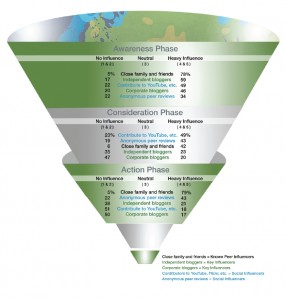
The recent study by Razorfish on social media marketing entitled Fluent, has some great data about marketing in a social media context.  The study clearly identifies your friends as crucial in the Awareness and Action phase, while the general Consideration phase people tend to rely on other sources for information:

Role of influencers in marketing funnel (Source: Razorfish)

Not much of a shocker of course, but good to see it in the context of the marketing funnel. However, the study fails to take into account an important behavioral aspect of social media.  As research has proven several times, social media is really about hanging out with your friends in an online setting.  Razorfish makes a somewhat of a big point of your “online friends” being less important than say TV ads, while your offline friends are the real key. Well, yes, but your “offline” friends are predominantly your “online” friends as well.  I assume (although this can not be extracted from the report), that Razorfish’ definition of Online Friend excludes anyone you would categorize as a an Offline Friend. Based on what we know about online behavior at social networks, this “online friend” group becomes a really small and insignificant portion of anyone’s life anyway.

This statement is quite interesting: “[the consumer disbelief in the authenticity of online banner ads] underscores the
importance of ad units evolving to work with users’ behaviors in digital media, including social networks”
. The decline in the effectiveness of banner ads has been known for a while, but this study puts it in the context of why consumers ignore them: they feel they are not authentic and simply not relevant.  The recommendation from Razorfish is spot on, and this is the exact principle we have built our business on at Storyz (feel free to check out a pitch deck).

Razorfish introduces an interesting measure, the Social Influence Marketing score (SIM), which is basically a measure of the positive and negative conversations about your brand compared to the rest of the industry. This is indeed a very interesting measure, it does, however, ignore some aspects of brand interaction that does not necessarily have to do about talking about the brand, but engaging in activities in a branded context. For instance, if you are attending a Coca Cola music festival, you may not spend a second talking about Coca Cola, but afterwards you may be very positively inclined towards Coca Cola because you had a great music experience where their brand was everywhere. Still, the SIM score is an interesting measure, but as a standalone it is somewhat meaningless unless measured over time and compared to market share/financial performance. SIM could indeed be a leading indicator for financial performance in a balanced scorecard for a corporation, but it needs to be proven.

The Razorfish report contains a very good section on how to create social media ads, which is definitely worth a read. Towards the end, it can of drifts onto a number of articles, which is more like the stuff you will see every day on Mashable and other sites.  For hard core data, their Feed report is still among the best.

Posted in Social Media Marketing.

Tagged with , , , , , , , , , , .


Mobile game developer headaches continue

Having been involved with the mobile games industry for nearly a decade, I cannot say anything but the words made famous (?) by Bill Clinton: “I feel your pain”.  It was hard enough starting out, dealing with MIDP 1.0 and all the various implementations of Java and varying device capabilities you had to deal with back in early 2000s.  MIDP 2.0 and the JCP took long steps to alleviate the pain and aid developers, and porting platforms such as JavaGround and those from Mobile-Distillery made it even easier.  Then of course you add additional OS, such as Symbian, Windows Mobile, BlackBerry, BREW, Palm OS and now lately Android, Apple and Web OS from Palm, and throw in Flash Lite, and various widget frameworks from Opera and others, and you have any small company’s living nightmare.  The choice of what to support usually coincided by what the distribution channel demanded, which was typically dictated by the mobile operator.dog headache

With the amazing success of the AppStore, a lot of smaller shops decided to drop all other platforms and go for gold with the iPhone.  Naturally, as the market evolved, the platform became less attractive, as you had to spend a lot on marketing to keep up the sales.  Now enter the inevitable, but obvious path: an upgrade to the iPhone OS, causing further device fragmentation.  Now the developer again are left to support multiple versions within the same OS.

Pure app developers tend to get off a bit easier, as they use less functionalities than games developers do.  This means they may not have to re-purpose their apps to the upgraded OS from Apple. However, there is no doubt that this will impact on several app developers too.

Will this fragmentation end?  Probably not, in fact, it is likely to get worse, as Android expands, and new versions of WM get published, as a developer you may not have a choice in supporting them all.  If you are in the mobile app business, you simply have to design smarter and rely on porting platforms and testing platforms such as those from DeviceAnywhere to help you, which will at least mitigate part of the headache. I feel your pain.

Posted in Mobile Entertainment, The Business of Mobile.

Tagged with , , , , , , , , , , .