Skip to content


AT&T Setting New Low for Customer Service

As a follow up to my previous article about mobile operators and data, let me now show you how NOT to deal with customers wanting to use data services.  I travel frequently, thus have multiple SIM’s, including one with AT&T which I’ve had for 5 years.  One of my phones is an unlocked iPhone from Australia, which since I do demo’s of my company’s Storyz application, need to run with an AT&T SIM.   AT&T emailed me and said I needed to have an iPhone data plan or they would shut down my data capabilities. I complained to customer service and said this is not an AT&T iPhone, and only used ocassionally, thus I should not be forced into an iPhone data plan.  This is the response I got:

stupidity“Unfortunately, because the iPhone is a data specific phone you are required to have an iPhone data plan on the account if you are going to use it. This would include using it temporally or even occasionally. All our data specific phones require a data plan and that is not limited to where the phone was purchased or unlocked or even if it was not exclusively used on the AT&T network originally. Since the iPhone is used without the correct data plan your data services will be blocked in the fall of 2009.”

Hey, AT&T, get this:  This iPhone is not your data specific phone. I have been a customer since 2005. I once racked up $200 in data usage for 5 days use at a conference. You should be very happy to have me as a customer.  We’ll now I am leaving. And I am actually a bit sad that I have yet another example of behavior from a mobile operator that many people feel is killing the market for mobile content and data.   A side note is that I actually have a data plan on this subscription too, just not an iPhone data plan.

I would like to point out that this kind of practice would be deemed illegal in several markets in the Western world. So while I am still a proponent of pushing data plans, this kind of approach simply will not do as it puts subscribers off it completely.
Posted in The Business of Mobile.

Tagged with , , , , , .


The Beatuy of Being a Bitpipe

After a well deserved holiday, one of the things I dread most is tackling the overblown email inbox.  I tend to let industry news be uninteresting news and delete the 1000+ newsletters I had received, and discovered I nearly deleted one from AT&T which was about my mobile subscription.  Since I travel quite frequently, I have several mobile phones and also several SIM cards. In this case, AT&T had noticed that I had put my AT&T SIM into an iPhone.  Despite my iPhone has been bought in Australia, and the fact that I did not buy it at AT&T – but that I do have a $10/month data plan connected to my SIM, I was now warned that “an eligible data plan is required as part of your service agreement”.  Now this post is not about bashing the stupidity of AT&T for penalizing me for putting the SIM into a foreign iPhone, rather it is AT&T’s aggressive policy of demanding that you have a data plan.

AT&T has flip flopped more than the average politician about the importance of content to their strategy. From saying that it is key to their survival which all telcos did at one point (see for instance this article for proof of recent emphasis on content), to saying it was never any important, their struggle exemplifies what their peers just cannot figure out or strategically coming to terms with: What role to play in the mobile content value chain.

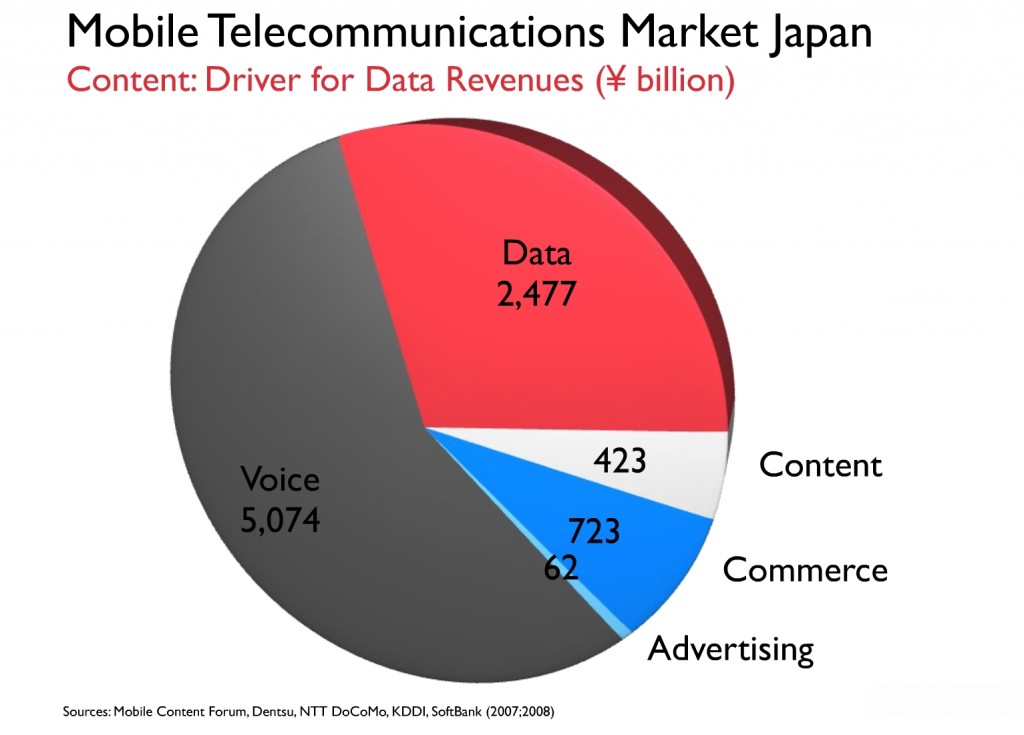
The answers of course, have been obvious and available for years by studying markets such as Japan, South Korea and Norway. And now, it may seem that AT&T has finally figured it out (or at least stumbled upon it in a good way).  The fact is, there is absolutely nothing wrong with being a bitpipe.  In fact, the market for mobile content and services will not take off fully until all mobile operators in a market realizes this.  The data from Japan are possibly the best indicator:

Mobile Telecom in Japan

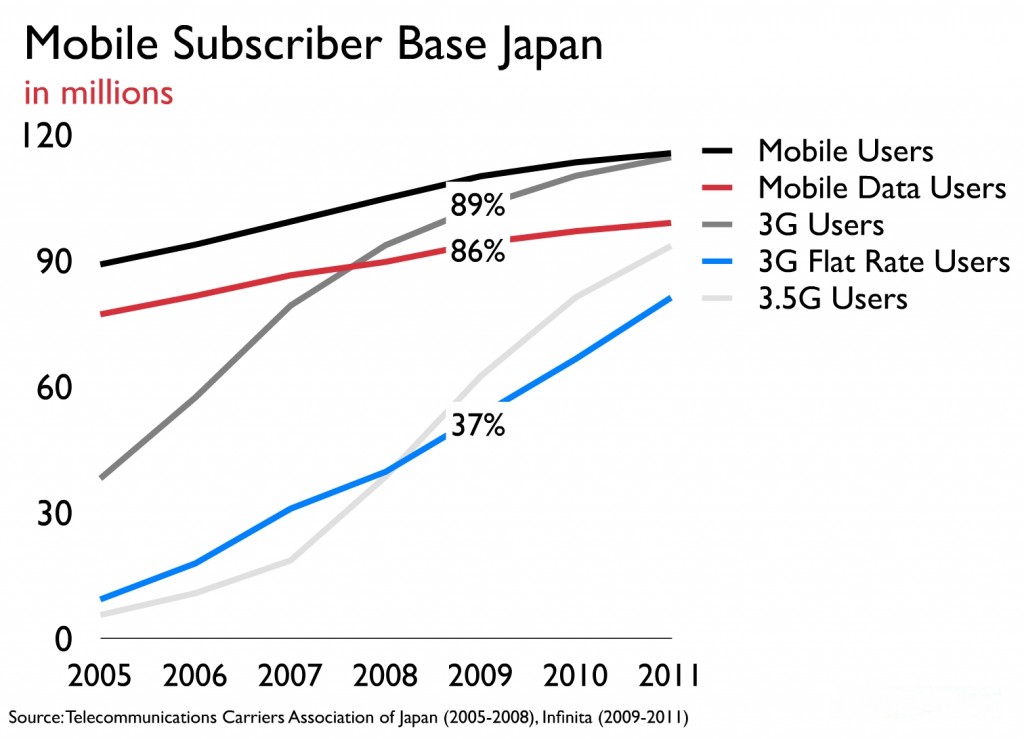
Note that of the mobile content revenue referred to in this chart, the mobile operator only keeps 10% while the rest is passed to the content provider. However, the mobile operator keeps 100% of the data revenue, implying that data is 60 x as important as content for the ARPU of a mobile operator.  The continued explosive growth in Japan can partly be attributed to the fact that 40% of subscribers in Japan are on a flat rate data plan:

Flat rate subs in Japan

(Courtesy of Infinita).

The subscribers on flat rate data plans often consume 1,5-2,5x the amount of content services, so with a little luck, it could be that AT&T has laid the foundation for data growth in the US. Of course they need all users on flat rate, not just iPhone owners – and all the other carriers need to follow in order for this to happen, but you have to start somewhere…

Posted in The Business of Mobile.

Tagged with , , , .


Why Twitter is the online marketing guru’s dream

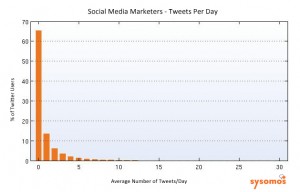
There have been a few interesting behavioral studies on Twitter lately (see my post from June about identifying influencers to see some research).  The latest one from research agency Sysomos is a very interesting read.  It not only confirms the Harvard Research study that very few users are active, but if you read the statistics on Twitter use by “Social Media Marketers” (however they have defined that), it seems like Twitter’s main purpose is self promotion.

Self fulfilling prophecies: Social Media Marketers
differ significantly in Tweets, followers and followees

Social Media Marketers - Tweets per day

Another aspect Sysomos confirms are observations made by AdAge:  A large part of Twitter’s growth in recent months is due to a vast amount of media coverage.  According to AdAge, the free press they got in June alone was worth 48m.  This is all start-ups’ dream I’m sure, and seem to be just self re-inforcing the marketing industry’s fascination with Twitter.

I am probably being a bit harsh on Twitter, I just find it such a waste of time, and aside from being a tool for customer support and a way to communicate with extremely loyal consumers (who would have found ways to find info about your products anyway), I just don’t see Twitter as the end all and be all of marketing platforms that brands need to be on.  But it just seems like why certain marketers are such strong proponent of Twitter may not be because they feel it is so relevant for brands to engage with, rather it is because they have become inundated with their sudden status of “fame”.  Of course, I am about to publish this article on Twitter, so I should perhaps just be quiet… 🙂

Posted in Social Media Marketing.

Tagged with , , , .