Two of the best resources for free research on the wireless industry, Wedbush Securities and Chetan Sharma, released their usual reports within a fairly short time of each other, and both reveal some interesting trends. Scott Sutherland of Wedbush is among the sharpest in the industry, and reading the Wedbush reports always gives some good insights. In their latest update, once you get past Scott’s continuous and endless love affair for messaging and hardware infrastructure, there are some statistics which are worth noting for marketers and media professionals:
Smartphones are growing, but ignore the rest at your peril
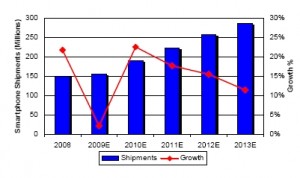
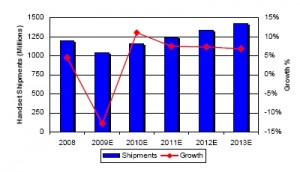
The graphs below shows that 2009 was a tough year for handset makers which everyone knows, but that shipments are expected to pick up. Also, as the iPhone has paved the way for smartphone ownership by the non-techie and non-business consumers, a fairly healthy growth in smartphone shipments is expected as well:
Smartphone Shipments (millions) and Growth / Handset Shipments (millions) and Growth
(Source: Wedbush and IDC)
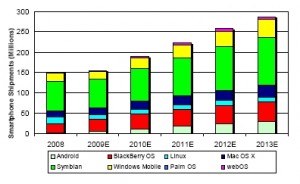
While the smartphone growth is impressive, the total shipments by 2013 is only 300m compared to the total of 1.4bn. Naturally, replacement cycles for smartphones may be longer, which means the proportion of smartphone ownership may be slightly higher than the proportion of shipments, it means you cannot ignore feature phones. Furthermore, when you look at the stats for expected market share of various smartphone OS, you once again see that the iPhone is far from the only game in town (although I feel the analysts may underestimate Android):
Smartphone Shipments by OS
(Source: Wedbush and IDC)
Data growth in the future is not all about smartphones
I have never been a big fan of market sizing predictions, and often feel analysts from Forrester, IDC and the likes could probably do well as weather forecasters and vice versa. However, research from Cisco and Wedbush reveals some very interesting expectations on data growth:
Mobile Data Traffic PB/Month and Growth

(Source: Cisco VNI 2009 and Wedbush. 1 Petabyte = 1 million Gigabytes)
Going from less than 100 PB/Month to 2200 PB/Month, i.e. a 22 times increase in mobile data traffic in 4 years is a staggering prediction. These are the kind of numbers that make VCs salivate.
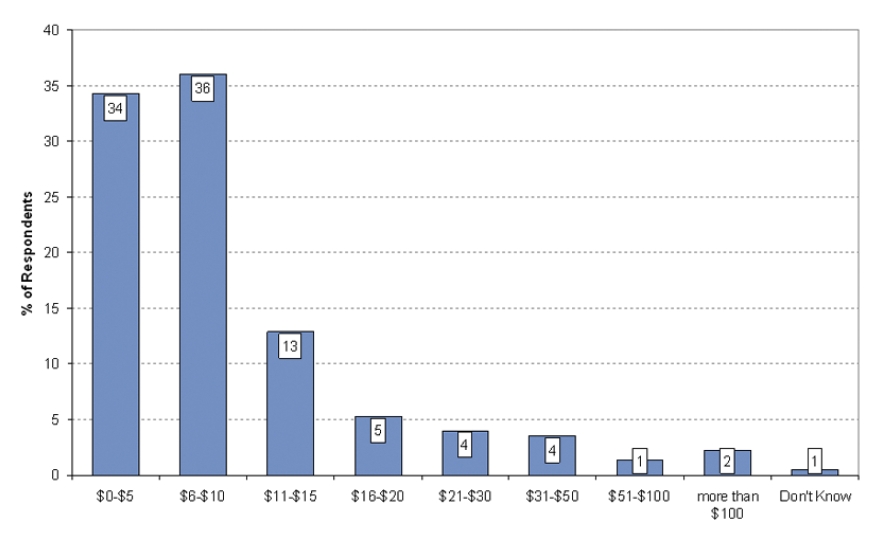
What becomes even more interesting is if you look at how data traffic is distributed among users today. According to Ericsson and Wedbush, 70% of the data traffic is driven by less than 5% of mobile data users:

(Source: Ericsson 2009 NA and Wedbush. 1 Petabyte = 1 million Gigabytes)
This graph verifies a lot of other research pointing to that smartphone users, and especially iPhone and BlackBerry users are driving a lot of the data traffic. If we are to achieve anywhere near the predictions of data volume that Cisco thinks, the growth cannot be attributed to the growth of smartphones, which is expected to only jump less than 2 times the current level in 4 years. Clearly the market has high expectations to both the overall awareness of mobile as a data channel and that feature phone users will jump on board to become data users in a large scale – and clearly the experts must assume that mobile operators will freely roll out reasonable data plans to allow this to happen. If you then look at research from Chetan Sharma, you will see that if the current picture of where data consumption occurs also is the main driver of future consumption, the main drivers of achieving this scenario will be from users in Japan, Sweden, Australia, the US and the UK:
Wireless Data ARPU Global Mobile Operators

Supply and Demand for mobile data
So how exactly will this data growth be achieved? There must be fundamental expectations to shifting the supply and demand curve. Let’s look at some potential supply side changes (the lists are only intended to provide a few examples):
- Increased availability of data plans, lower prices, more AYCE plans
- More new companies offering cool services
- Massive take-up/push by existing companies
There will certainly be a push among mobile carriers to offer data plans, but so far they are tied to smartphones or use of certain services (like “free” access to Facebook, etc), and a full scale roll out of data plans to feature phones – and especially the pre-paid segment – is likely to take some time as carriers need economies of scale to bring the prices down to an affordable level for these segments. As for new companies, well, Q1 2009 was the worst in a long time for VC investments according to PWC, with Telecoms investements dropping from $510m in Q2 2008 to $95m in Q2 2009. As for media companies starting to push more and better quality mobile services, this trend does seem to happen as industry insiders will attest to.
When looking at the demand side, there are a number of factors that need to be in place in order for consumers to even be aware that they should want mobile data:
- Overall awareness of mobile services by consumers in terms of what is available
- Better retail of mobile services, so consumers understand they should get data plans and start using them
- Increased advertising of mobile services by mobile operators, handset vendors and media companies
The explosion in the use of social networking on mobile certainly addresses part of the first point. The second point is not very well addressed by mobile operators today. Very few, outside of H3G staff, are incentivized to push content and data plans at the retail level. On the third point, I have yet to see a whole lot of ads for mobile services outside of Apple’s “there’s an app for that” and early attempts by Nokia to push Ovi. Telstra does push content services here in Australia, but along with H3G they seem to be the exceptions in Western markets. And I have yet to see a whole lot of push by media companies for their mobile services. It rather seems that up until now mobile has been seen as a necessary evil to complement your online offering, but not as something which can bring you a competitive advantage (talk to anyone trying to pitch a media company and you will hear about the (lack of) size of their mobile budgets). However, we are seeing the beginnings of media using mobile to get ahead by the likes of CNN and others.
I think the predictions for rise in data consumption seem extremely lofty. I doubt mobile operators will be that quick to roll out AYCE data plans and other reasonable data plans for their entire subscriber base. Also, it takes a long time to change user behavior (see for instance my article on the adoption of mobile video), and although typical feature phone buyers will eventually start requiring data plans, it will hardly happen over the next 4 years. Also, take into account that Cisco’s estimates of mobile data growth are largely driven by mobile video, expected to account for 64% of the data, you get somewhat skeptical knowing the severe constraints that mobile video has once networks get overloaded, the lack of compelling content and associated business models, and the constant predictions of “this is the year of mobile video”.
But if the predictions are even half right, it seems like a good time to be in the mobile content/marketing area…




Recent Comments